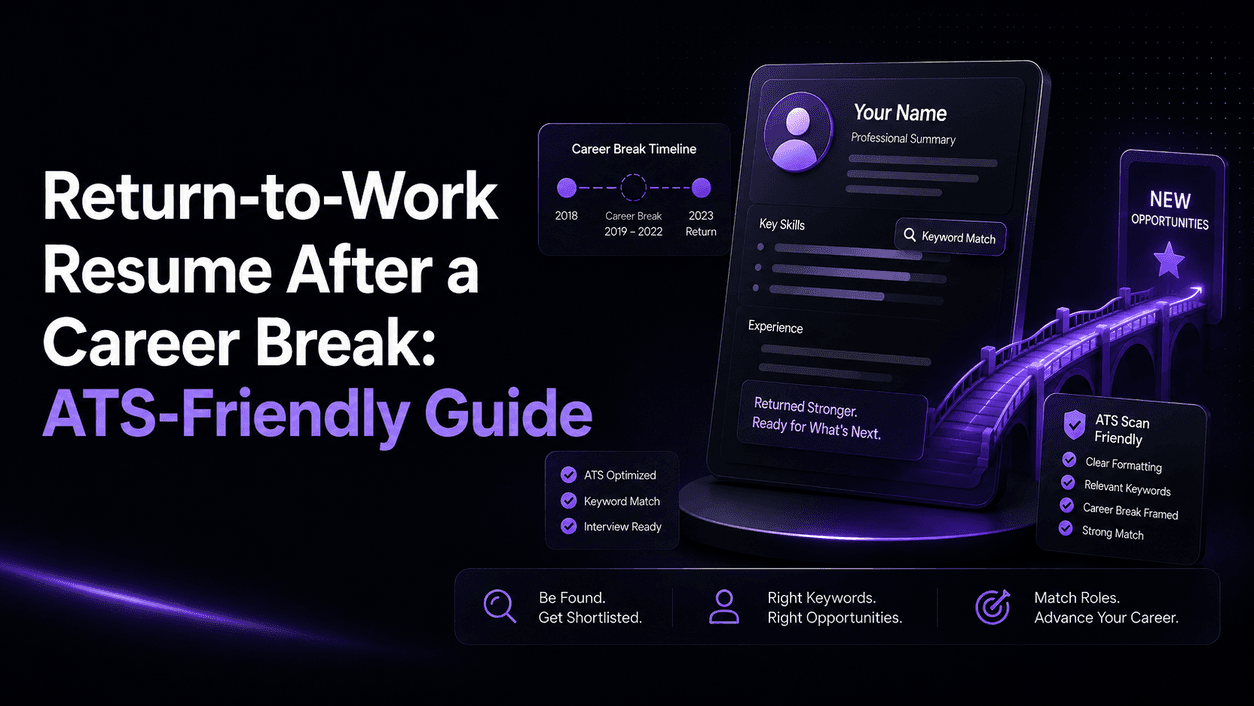
Returning to work after a career break can feel awkward on a resume, but it does not have to look like a weakness.
Whether you stepped away for caregiving, health, parenting, relocation, study, travel, burnout recovery, or personal reasons, your resume should do two things: explain the timeline clearly and move the focus back to the value you can bring now.
This guide shows how to write a return-to-work resume after a career break in a way that is honest, confident, and ATS-friendly.
What Employers Need to Know
Most employers are not trying to punish a career break. They are trying to answer practical questions:
- Are your skills current?
- Are you ready to return to consistent work?
- Can you explain the gap briefly and professionally?
- Do your past achievements still match the role?
- Have you done anything relevant during the break?
Your resume should answer these questions without over-explaining your personal life.
Choose the Right Resume Format
For most return-to-work candidates, the best format is a hybrid resume:
- Short professional summary
- Skills section near the top
- Recent career break or professional development note if needed
- Work experience in reverse chronological order
- Education, certifications, volunteer work, or projects
Avoid a fully functional resume if you can. Functional resumes often hide dates, which can make recruiters more suspicious and may be harder for ATS systems to parse.
For layout rules, use our ATS-friendly resume format guide.
Write a Confident Return-to-Work Summary
Your summary should not apologize for the break. It should frame your relevant background and readiness.
Example for project management:
Project coordinator returning to full-time work after a planned caregiving
career break. Brings 5 years of experience coordinating timelines, vendor
communication, reporting, and cross-functional project updates. Recently
completed Google Project Management Certificate and ready to support fast-moving
operations teams.
Example for marketing:
Digital marketing specialist with 4 years of experience in email campaigns,
SEO content, social media planning, and performance reporting. Returning after a
parental career break with recent HubSpot and Google Analytics coursework.
Skilled at turning campaign data into practical growth recommendations.
For more options, see these resume summary examples.
How to List the Career Break
You do not always need to list a career break as its own entry. It depends on length and context.
Gap Under 6 Months
Usually, no separate entry is needed. Use consistent dates and focus on your experience.
Gap Around 6-18 Months
You can mention it in your summary or cover letter, especially if it may be obvious from dates.
Gap Over 18 Months
Consider adding a short entry if you used the time for caregiving, study, freelance work, volunteering, or professional development.
Example:
Career Break / Professional Development | 2024-2026
- Completed Google Data Analytics Certificate and refreshed Excel, SQL, and
  Tableau skills through applied projects
- Volunteered with local nonprofit to organize donor spreadsheet cleanup and
  monthly reporting
- Prepared to return to full-time analyst roles focused on reporting and
  operations support
Keep it short. The goal is to account for the time and show readiness, not write a personal essay.
For more gap-specific wording, read how to explain employment gaps on your resume.
What to Put in Your Skills Section
Your skills section matters because it helps both recruiters and ATS software understand what you can do now.
Include:
- Tools you can use today
- Certifications or recent coursework
- Role-specific hard skills
- Transferable skills that match the job description
Example:
SKILLS
Project Coordination: timelines, status reporting, stakeholder updates
Tools: Excel, Asana, Trello, Google Workspace, Slack
Data & Reporting: dashboards, KPI tracking, spreadsheet analysis
Communication: meeting notes, documentation, cross-functional coordination
Do not list every skill you have ever used. Prioritize the skills that appear in your target job postings.
Turn Break Activities Into Resume Value
Not every break activity belongs on your resume, but some activities can support your return.
Good candidates for resume inclusion:
- Certifications
- Freelance projects
- Volunteer work
- Consulting
- Caregiving logistics that relate to your target role
- Personal projects with measurable output
- Coursework with real assignments
Less useful:
- Vague "self-improvement"
- Personal details unrelated to work
- Activities that distract from the target role
If you include break-period work, describe it like professional experience: action, scope, tools, and outcome.
Return-to-Work Bullet Point Examples
Weak:
- Took online courses during career break.
Stronger:
- Completed 6-course Google Data Analytics Certificate, building SQL, spreadsheet, and Tableau projects using real-world business datasets.
Weak:
- Helped with school fundraising.
Stronger:
- Coordinated donor spreadsheet cleanup and email outreach for school fundraiser, helping team track 300+ contacts and improve follow-up visibility.
Weak:
- Managed household and caregiving responsibilities.
Stronger:
- Managed complex family caregiving schedule, coordinating appointments, documentation, budgeting, and vendor communication during planned career break.
Use caregiving examples carefully. They can be relevant for operations, coordination, administration, healthcare, education, or support roles, but you do not need to include personal details.
For more patterns, use our resume bullet point examples.
Match the Job Description
Return-to-work candidates often undersell themselves by sending the same resume everywhere. Tailoring matters even more after a break.
For each job:
- Identify the target title.
- Pull 8-12 important keywords from the posting.
- Compare those keywords against your resume.
- Add honest matches to your summary, skills, and bullet points.
- Remove older experience that does not support the role.
Use the resume vs job match tool if you want to compare your resume against a specific posting.
Should You Use a Cover Letter?
Yes, a short cover letter can help.
Your resume should stay focused on qualifications. The cover letter can add one sentence of context:
After a planned career break for caregiving, I am excited to return to
operations coordination and bring my background in reporting, scheduling, and
cross-functional communication to your team.
Then move on. Do not spend the whole letter explaining the break.
Return-to-Work Resume Checklist
Before applying, check that your resume is doing the right job:
- Summary names your target role or role family
- Skills section reflects current, job-relevant skills
- Career break is addressed briefly if needed
- Recent learning, volunteering, or project work is included when relevant
- Older experience is rewritten with results and metrics
- Dates are consistent and honest
- Format is simple enough for ATS parsing
- Resume is tailored to the exact job description
If you want a second pass on structure, use the free ATS resume checker.
Key Takeaways
- A career break does not need to dominate your resume.
- Use a short summary to show readiness and relevant background.
- Add a career-break entry only when it helps explain a longer gap.
- Highlight recent skills, certifications, projects, or volunteer work.
- Tailor every return-to-work resume to the job description.
The strongest return-to-work resume is honest, current, and forward-looking. It explains enough to remove doubt, then spends most of its space proving that you can do the job now.