Software engineering resumes have unique requirements. Hiring managers are looking for specific signals, and ATS systems scan for particular keywords.
This guide covers what actually works for developer resumes—based on what engineering hiring managers say they look for.
What Engineering Hiring Managers Look For
Top 5 Things They Scan First
- Most recent role and tech stack — Are you working with relevant technologies?
- Company names — Recognition helps (but isn't required)
- GitHub/Portfolio — Evidence of code over claims
- Education — Quickly confirms fundamentals
- Resume quality — Sloppy resume = sloppy code (in their mind)
Red Flags That Get You Rejected
- Buzzword stuffing with no depth
- Listing every technology you've ever touched
- No measurable achievements
- Overly designed/creative format
- Typos or inconsistencies (developers are expected to be precise)
The Ideal Software Engineer Resume Format
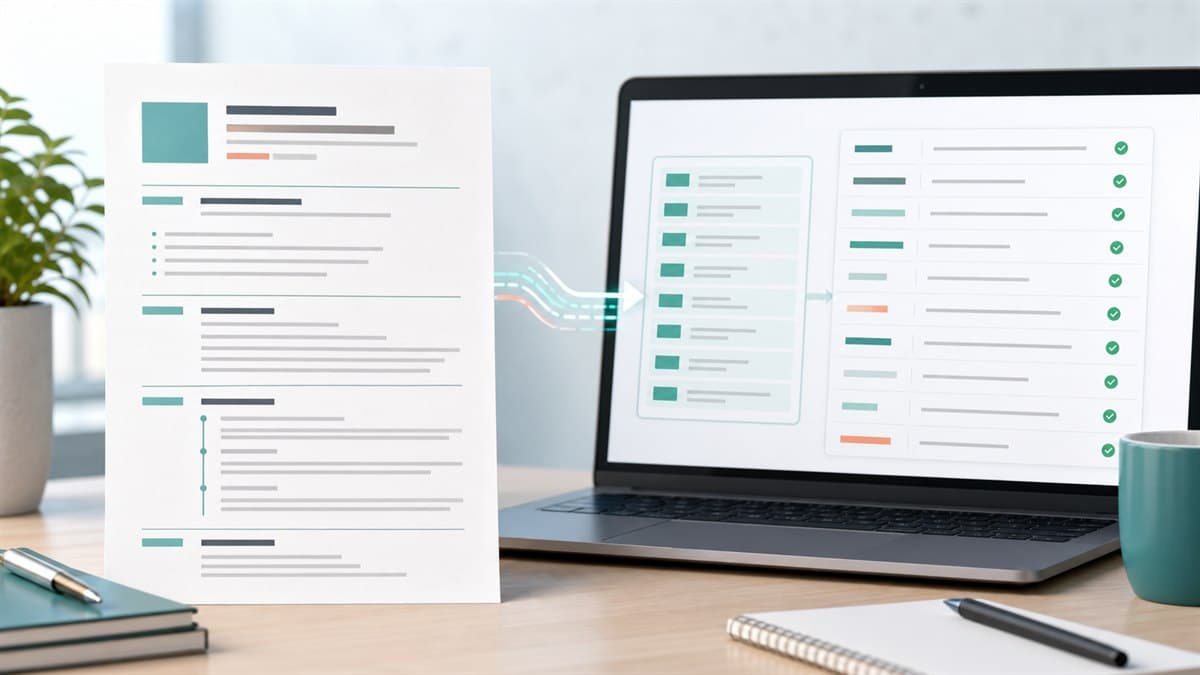
For most engineering roles, the safest layout is still a clean, single-column resume with standard headings. If you are using a template, compare it against the ATS-friendly resume format guide before you send it through an online application.
Header
JANE DEVELOPER
San Francisco, CA | jane@email.com | (555) 123-4567
github.com/janedev | linkedin.com/in/janedev | janedev.com
Always include GitHub and portfolio links.
Technical Skills Section
Place this near the top. Organize by category:
TECHNICAL SKILLS

Languages: Python, JavaScript/TypeScript, Go, SQL
Frontend: React, Next.js, Vue.js, Tailwind CSS
Backend: Node.js, Django, FastAPI, GraphQL
Cloud/DevOps: AWS (EC2, S3, Lambda), Docker, Kubernetes, Terraform
Databases: PostgreSQL, MongoDB, Redis
Tools: Git, CI/CD (GitHub Actions, Jenkins), Datadog
Tips:
- List proficient technologies only (things you could discuss in an interview)
- Order by relevance to target jobs
- Include version control and CI/CD tools
- Don't list basic skills (HTML, CSS, Git basics)
Work Experience
Format:
Software Engineer
ACME Tech Corp, San Francisco, CA | March 2023 – Present

• Architected and built real-time notification system using WebSocket
  and Redis pub/sub, handling 50K concurrent users with <100ms latency

• Reduced API response times by 40% through query optimization and
  caching strategies, improving user satisfaction scores

• Led migration from monolith to microservices, enabling team to
  deploy 5x more frequently with zero-downtime releases

• Mentored 3 junior developers, established code review standards,
  and created internal documentation reducing onboarding time by 30%

Tech: Python, FastAPI, PostgreSQL, Redis, AWS, Docker, Kubernetes
Key elements:
- Start with impact (built, reduced, improved)
- Include scale numbers (50K users, 40% improvement)
- Mention technical decisions and architecture
- List technologies used for each role
- Show growth/leadership even in IC roles
Quantifying Developer Achievements
Developer bullet points work best when they combine action, technical scope, and measurable impact. If you want more patterns, use the before-and-after examples in our resume bullet point examples guide.
Performance Improvements
- "Reduced load times by X%"
- "Improved API response from Xms to Yms"
- "Decreased error rates from X% to Y%"
- "Optimized queries reducing database load by X%"
Scale Numbers
- "Handled X concurrent users"
- "Processed X transactions per second"
- "Managed X TB of data"
- "Supported X daily active users"
Business Impact
- "Feature drove $XM in new revenue"
- "Reduced infrastructure costs by $XK/month"
- "Automation saved X hours per week"
- "Increased conversion rate by X%"
Team/Process Impact
- "Deployed X% more frequently"
- "Reduced bug rate by X%"
- "Onboarded X new engineers"
- "Established standards adopted by X teams"
If You Don't Have Exact Numbers
Estimate reasonably or use ranges:
- "Improved performance by approximately 30-40%"
- "Handled tens of thousands of daily requests"
- "Reduced significant technical debt"
Projects Section (Crucial for Junior Developers)
What Makes a Project Impressive
- Deployed and live — Not just local development
- Real users — Even a few hundred matters
- Technical complexity — Shows problem-solving ability
- Clean code — GitHub must be presentable
Project Format
PROJECTS

TaskFlow | Live: taskflow.dev | Code: github.com/you/taskflow
Full-stack task management app with real-time collaboration
• Built with Next.js, TypeScript, PostgreSQL, and WebSocket
• Implemented authentication with JWT and OAuth
• Deployed on Vercel with CI/CD pipeline
• 500+ active users, 4.5-star rating

Open Source Contribution: React Query
• Contributed performance optimization merged into v4 release
• Fixed memory leak affecting 10K+ projects
Projects to Avoid
- Todo apps with no unique angle
- Tutorial follow-alongs without modifications
- Incomplete or broken projects
- Private repos you can't share
GitHub Profile Optimization
Your GitHub is part of your resume. Optimize it:
Profile README
Create a profile README (github.com/yourusername/yourusername) showcasing:
- Brief introduction
- Tech stack with icons
- Featured projects
- Activity stats
Pin Your Best Repositories
Pin 6 repos that show:
- Range of skills
- Clean, documented code
- Actual functionality (not tutorial code)
Clean Up Your Repos
- Archive or delete embarrassing old projects
- Add READMEs to all pinned repos
- Ensure code is well-commented
- Remove any secrets or credentials (use git filter-branch if needed)
Education Section
For Experienced Engineers (5+ years)
Brief is fine:
EDUCATION
BS Computer Science, State University, 2018
For New Grads / Career Changers
More detail helps:
EDUCATION
BS Computer Science, State University | May 2024
GPA: 3.7 | Dean's List
Relevant Coursework: Data Structures, Algorithms, Database Systems,
  Distributed Systems, Machine Learning
Senior Project: Built ML-powered recommendation engine (Python, TensorFlow)
For Bootcamp Grads
Include, but focus on projects:
EDUCATION
Full Stack Web Development Certificate
App Academy, San Francisco | 2024 (1,000+ hours)

BS Business Administration, State University, 2020
ATS Keywords for Software Engineers
Common ATS keywords by specialty:
Backend
Python, Java, Go, Node.js, REST API, GraphQL,
microservices, Docker, Kubernetes, AWS, GCP, Azure,
PostgreSQL, MySQL, MongoDB, Redis, Kafka,
CI/CD, testing, TDD, Agile, Scrum
Frontend
JavaScript, TypeScript, React, Vue, Angular, Next.js,
HTML5, CSS3, Sass, Tailwind, responsive design,
state management, Redux, performance optimization,
accessibility, a11y, testing, Jest, Cypress
Full Stack
Combine both, plus:
full stack development, end-to-end,
system design, API design, database design
DevOps/SRE
AWS, GCP, Azure, Terraform, CloudFormation,
Kubernetes, Docker, Linux, Bash, Python,
monitoring, Datadog, Prometheus, Grafana,
CI/CD, Jenkins, GitHub Actions, GitLab CI,
incident response, SLO, SLA, observability
Resume Length for Developers
Junior (0-3 years): 1 page
Focus on projects, education, and any internships.
Mid-level (3-7 years): 1-2 pages
More experience detail, key projects.
Senior (7+ years): 2 pages
Can include architecture decisions, leadership, mentoring.
Never exceed 2 pages for industry roles (academic CVs differ).
Common Mistakes
Listing Too Many Technologies
❌ Every language and tool you've ever touched
✅ Technologies you could comfortably discuss in an interview
Not Showing Impact
❌ "Worked on backend systems"
✅ "Redesigned backend caching, reducing database queries by 60%"
Ignoring Soft Skills
Even for engineers, mention:
- Code reviews and mentoring
- Cross-team collaboration
- Technical documentation
- Architecture discussions
Over-Designed Resumes
Engineers should have clean, readable resumes—not creative portfolios. Save creativity for your actual portfolio site.
Software Engineer Resume Summary Example
Your summary should be short and specific, not a paragraph of buzzwords:
Backend software engineer with 5 years of experience building Python,
PostgreSQL, and AWS services for B2B SaaS products. Improved API latency
by 34% and helped migrate billing workflows from a monolith to event-driven
services.
For more role-by-role examples, see our resume summary examples.
Key Takeaways
- Lead with recent, relevant tech stack
- Always include GitHub and portfolio links
- Quantify everything—performance, scale, impact
- For juniors, projects are as important as experience
- Optimize GitHub profile as resume extension
- Use ATS keywords naturally, not stuffed
- Keep it to 1-2 pages with clean formatting
Your code speaks for itself—but first, your resume needs to get you in the room to talk about it.